The UK’s first trade agreement with the Gulf Cooperation Council is now signed, not just negotiated. Here is what actually changes for a British company weighing Gulf market entry.
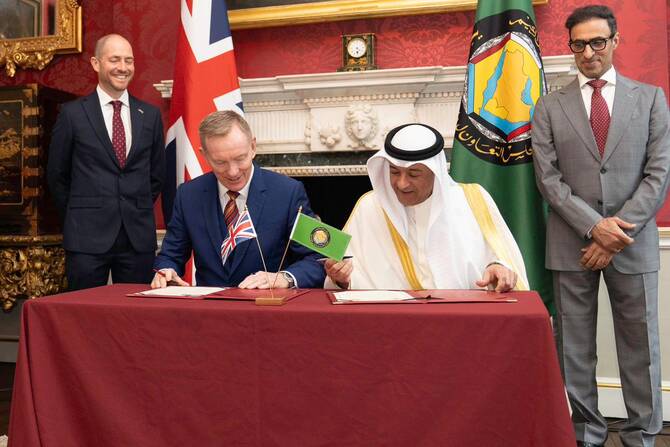
The Gulf Cooperation Council–United Kingdom Free Trade Agreement was signed on 20 May 2026, four years after negotiations opened in June 2022. It is the first free trade agreement between the UK and the GCC, or any of its six member states individually, and the first between the GCC and any G7 economy. The deal covers Bahrain, Kuwait, Oman, Qatar, Saudi Arabia and the UAE.
The headline numbers
The UK government’s own modelling, published alongside the signing, puts the agreement’s long-run value at an estimated £3.7 billion a year added to UK GDP and £1.9 billion a year in higher wages, compared with 2040 projections. Bilateral trade could increase by an estimated 19.8 per cent, adding roughly £15.5 billion a year. Total UK–GCC trade was worth £53 billion in the latest full year of data, of which £17 billion was services.
What actually changes for a market entrant
- Tariffs: an estimated £580 million a year in duties on UK goods exports to the GCC will be eliminated once the agreement is fully implemented, with £360 million of that removed from day one. Food and drink is a specific beneficiary – cereals, cheddar cheese, chocolate and butter are named examples – relevant given the GCC imports over 80 per cent of its food.
- Services access: services make up around 80 per cent of the UK economy and around half of UK exports to the GCC, and the agreement locks in guaranteed market access for UK services exporters, described by government as providing renewed certainty rather than a new right of entry.
- Business mobility: visa processes for UK professionals working in the Gulf are intended to become fairer, more efficient and increasingly digital, relevant given over 400,000 business visits were made from the UK to the Middle East in 2024 alone.
- Customs speed: the agreement includes what government describes as the most ambitious customs commitments the GCC has signed with any partner, with clearance targeted within 48 hours and perishable goods within 6 hours once requirements are met.
- Data: UK companies will be able to store and process data outside the Gulf region for the first time under the agreement, removing the previous need to set up in-region data centres purely for compliance reasons.
- Investment protection: the agreement includes a framework for resolving investment disputes, relevant against £18 billion in bilateral investment recorded in 2024, including infrastructure projects such as Heathrow Airport.
What this means for UK firms
For a UK company weighing Gulf market entry, the practical shift is less about any single tariff line and more about certainty. Services access, visa treatment and data handling have moved from negotiated aspiration to signed commitment, which changes the risk calculus for structuring a Gulf presence — whether that is a services engagement, a representation arrangement, or a first physical footprint in the region.
One point worth building into any timeline: the agreement is signed but not yet in force. The UK and all six GCC member states still need to complete their own domestic ratification procedures before businesses can trade under its terms, so the benefits above are not yet live and there is no confirmed date for entry into force.
The technical detail – sector-by-sector tariff schedules, rules of origin, and the exact scope of services commitments – sits in the Department for Business and Trade’s technical note (https://www.gov.uk/government/publications/uk-gulf-cooperation-council-free-trade-agreement-technical-note) published alongside the agreement, and any client-specific advice should be checked against that document directly rather than against summary reporting, including this one.
Sources: Department for Business and Trade and HM Government, “UK and Gulf strike historic multi-billion-pound trade deal”, GOV.UK, 20 May 2026; UK-Gulf Cooperation Council (GCC) trade deal: conclusion summary, GOV.UK, published 20 May 2026, last updated 10 June 2026; ONS UK total trade and travel trends datasets, as cited in the above release.