The competition between Saudi Arabia and the United Arab Emirates to attract international businesses has intensified into a structured, policy-driven race. Both markets are deploying increasingly sophisticated incentive packages designed to shift not just regional presence, but actual headquarters, capital allocation, and long-term operational commitment.
At the centre of this strategy is a clear objective: capture a greater share of multinational decision-making within the Gulf.
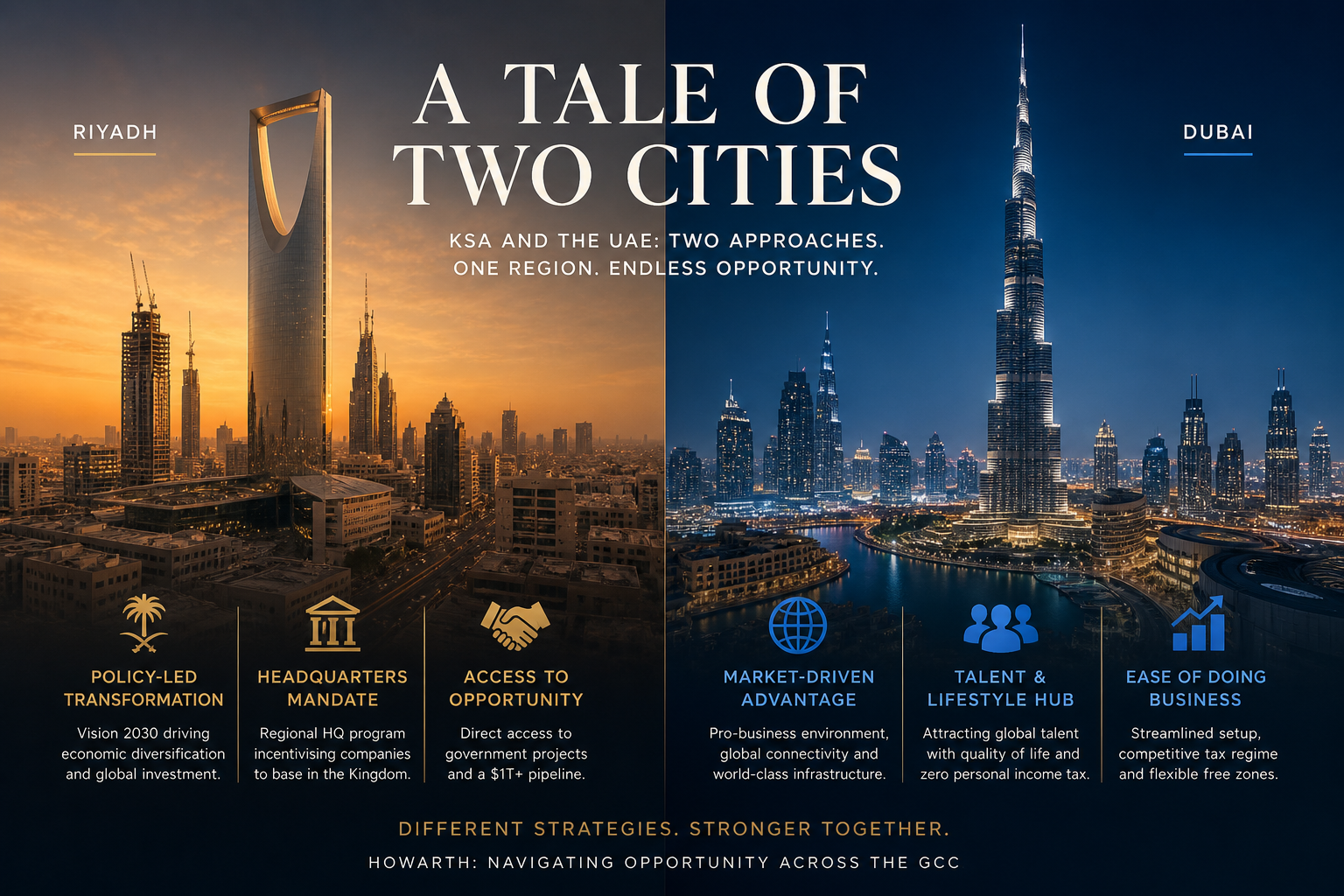
In Saudi Arabia, the Regional Headquarters (RHQ) programme has become the primary lever. From 2024 onward, companies seeking to secure government contracts are required to establish regional headquarters within the Kingdom. This is reinforced by a suite of incentives including tax concessions, simplified licensing, and regulatory support aligned with Vision 2030. The approach is directive and policy-led – designed to rebase corporate presence into Riyadh and anchor long-term economic diversification.
By contrast, the United Arab Emirates continues to adopt a more market-driven model. Long-standing advantages – quality of life, customer service excellence, zero personal income tax, established free zones, and streamlined company formation – have been complemented by corporate tax reforms that remain competitive by global standards. The UAE’s positioning is less about compulsion and more about frictionless operation, speed to market, and lifestyle-driven talent attraction, particularly in Dubai and Abu Dhabi.
The result is not a zero-sum outcome, but a bifurcated strategy emerging across the region:
- KSA is optimising for scale, localisation, and government-linked opportunity
- UAE is reinforcing its role as the region’s commercial, financial, and operational hub
For international firms, this creates a more complex decision matrix. A single “Gulf hub” model is increasingly insufficient. Instead, businesses are evaluating dual-presence strategies – locating headquarters functions in KSA to access state-driven opportunity, while maintaining operational, financial, or talent hubs in the UAE.
The implications are structural. Capital deployment, legal structuring, and operating models must now be designed with jurisdictional intent, not just regional coverage.
For firms entering or expanding within the GCC, the question is no longer where to base, but how to optimise across two competing, yet complementary systems.